About the ASP
Who administers the exam?
The Associate Safety Professional (ASP) certification is a widely recognized professional credential for individuals working in occupational safety and health.
This certification is awarded by the Board of Certified Safety Professionals (BCSP), a nonprofit organization dedicated to advancing the safety profession. Founded in 1969, BCSP develops and administers professional safety certification examinations and certifies qualified safety, health, and environmental practitioners who meet established education, experience, and examination requirements.
The ASP certification demonstrates a strong foundation in safety concepts and practices, including hazard identification and control, risk management, emergency preparedness, occupational health, ergonomics, environmental management, training, and safety management systems. ASPs apply these principles to identify and evaluate workplace hazards, recommend appropriate controls, support organizational safety programs, and contribute to improved safety and health performance.
The ASP is also an important pathway toward the Certified Safety Professional (CSP) certification. Individuals who earn the ASP credential satisfy the qualified credential requirement for pursuing the CSP, provided they meet BCSP’s other eligibility requirements.
What exactly does an ASP do?
According to the Board of Certified Safety Professionals (BCSP), an Associate Safety Professional (ASP) is a safety practitioner who has demonstrated knowledge of fundamental safety, health, and environmental (SH&E) concepts and safety assurance methodologies.
ASPs may work at the technical or program management level and may also directly supervise employees. They can serve as important members of project, operational, or design teams by applying their safety knowledge to identify hazards and reduce workplace risks.
The role and responsibilities of an ASP may include:
- Coordinating workplace safety and health activities.
- Conducting basic safety analyses and assessments.
- Identifying hazardous conditions and situations.
- Recommending appropriate risk-reduction and hazard-control measures.
- Overseeing the implementation of risk-reduction measures.
- Applying fundamental safety concepts and methodologies to workplace activities.
- Supporting safety programs, projects, operations, and design activities.
- Supervising employees and safety-related activities where applicable.
- Applying professional SH&E knowledge to help prevent workplace incidents, injuries, and exposures.
The ASP is both a standalone professional certification and an important pathway toward the Certified Safety Professional (CSP) certification. The ASP satisfies the qualified credential requirement for individuals who later wish to pursue the CSP.
Who qualifies for the ASP?
To qualify for the ASP certification, candidates must meet BCSP’s education and professional experience requirements.
At minimum, candidates must have:
Education: A bachelor’s degree in any field OR an associate degree in safety, health, or the environment (SH&E). For an associate degree to qualify, it must include at least four courses totaling at least 12 semester hours (18 quarter hours) of study in SH&E subject areas covered by the ASP examination blueprint.
Professional Experience: At least one year of safety, health, and environmental experience. At least 50% of this experience must consist of preventative, professional-level work involving sufficient breadth and depth of safety duties.
Candidates who obtained their degree outside the United States should also be aware that their education will be evaluated for U.S. equivalency as part of the BCSP application process.
Candidates must then successfully pass the ASP examination to earn the certification.
Note: BCSP certification requirements, examination policies, and fees may change. Candidates should always verify the latest requirements directly through the official BCSP website before applying.
How do you get certified for the ASP?
The ASP certification process begins by determining whether you meet BCSP’s education and professional experience requirements.
Once you meet the requirements, you can create a BCSP account and submit your ASP application and required documentation. BCSP will review the application to determine your eligibility.
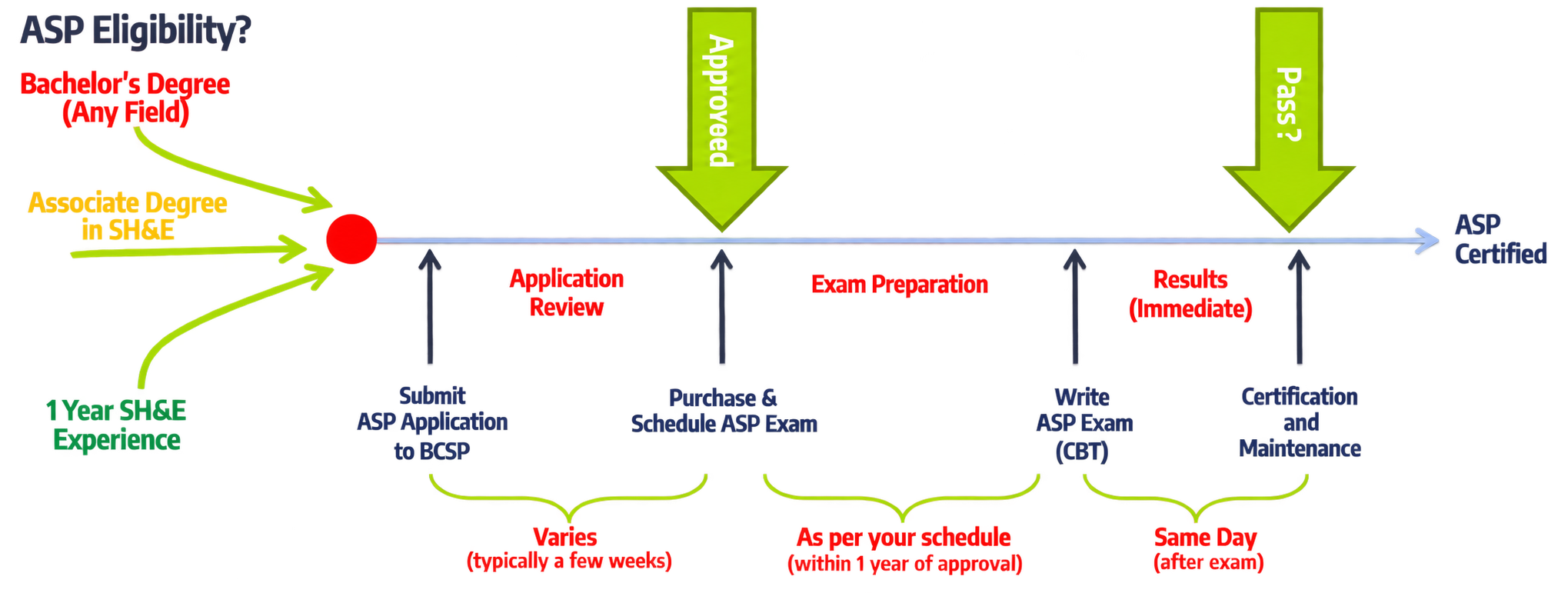
After your application is approved, you can purchase and schedule the ASP examination through your BCSP account. BCSP currently provides candidates with one year from approval of their application to take and pass the examination.
The overall process can therefore be summarized as:
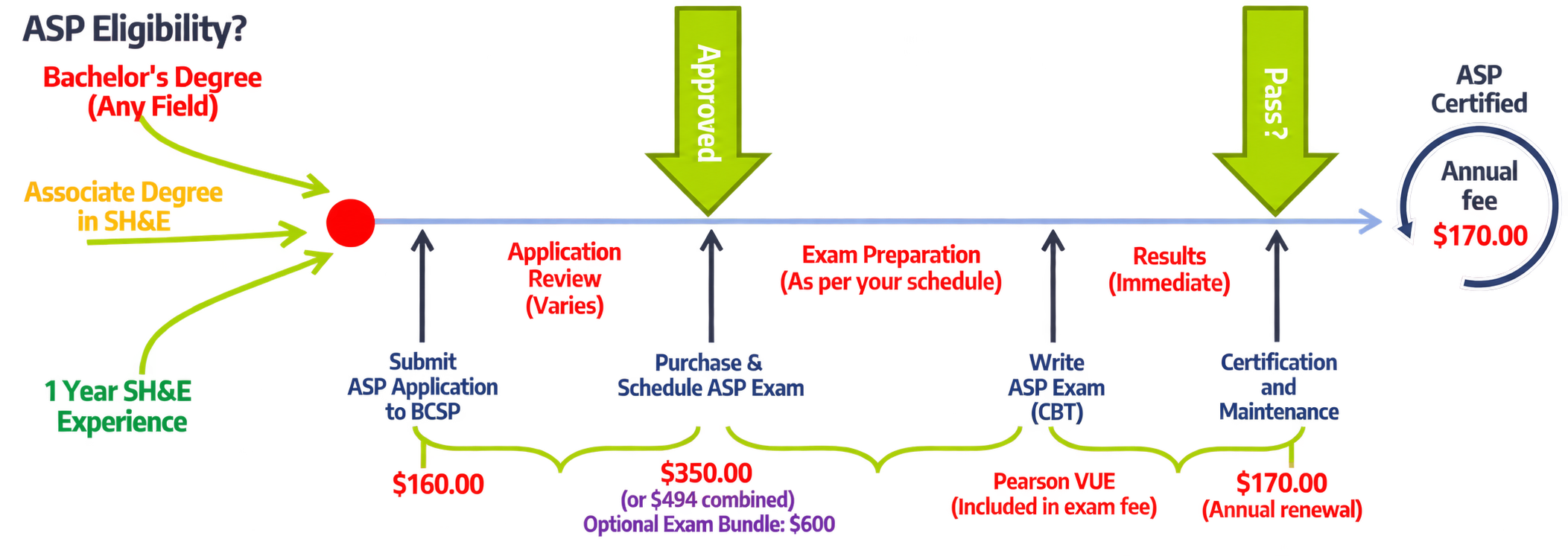
Meet ASP Eligibility Requirements → Apply to BCSP → Application Review and Approval → Purchase and Schedule the ASP Exam → Take and Pass the ASP Exam → Earn the ASP Certification → Maintain the Certification
After earning the ASP, certificants must maintain their credential by paying the applicable annual renewal fee and meeting BCSP’s recertification requirements. BCSP currently operates on a five-year recertification cycle.
Don’t forget to check out our crash courses!
Take control over your career.
Let’s break down each step and take a closer look.
Step 1: Determine Your Eligibility
The first step toward earning the Associate Safety Professional (ASP) certification is determining whether you meet the eligibility requirements established by the Board of Certified Safety Professionals (BCSP).
Unlike certifications that offer several different eligibility pathways, the ASP has a single set of education and professional experience requirements.
To qualify, candidates must have a minimum of a bachelor’s degree in any field or an associate degree in safety, health, or the environment (SH&E). If you are applying with an associate degree, the degree must include at least four courses totaling at least 12 semester hours of study in the SH&E subject areas covered by the ASP examination blueprint.
Candidates must also have at least one year of professional safety, health, and environmental experience. At least 50% of this experience must involve preventative, professional-level safety work with sufficient breadth and depth of safety responsibilities.
For example, if you work as a safety coordinator, safety specialist, occupational health and safety professional, or in another position where a significant portion of your responsibilities involves identifying hazards, assessing risks, developing controls, conducting investigations, supporting safety programs, or preventing workplace injuries and illnesses, your experience may contribute toward this requirement.
Candidates should carefully review the current BCSP eligibility requirements before submitting an application.
Step 2: Apply to BCSP
Once you determine that you meet the eligibility requirements, the next step is to apply directly to BCSP.
You can create an account through the BCSP My Profile portal and select the application for the ASP certification. The application requires you to provide information demonstrating that you meet the applicable education and professional experience requirements.
BCSP reviews the submitted application and supporting information to determine whether you are eligible for the certification examination.
It is important to make sure the information in your application is complete and accurate before submitting it. BCSP may verify information provided by applicants and reserves the right to request additional documentation when necessary.
Candidates with education obtained outside the United States should also review BCSP’s requirements regarding evaluation of international academic credentials.
Step 3: Wait for Application Review and Approval
After submitting your application and paying the applicable application fee, BCSP will review your information to confirm that you meet the ASP eligibility requirements.
Unlike some other certification processes, there is normally no separate regional screening committee interview as part of the standard ASP application process.
Once BCSP approves your application, you become eligible to purchase and schedule the ASP examination.
You should therefore apply early enough to allow time for the application review and any additional documentation that BCSP may request.
Step 4: Receive Approval and Purchase Your Exam
Once your application has been approved, you can purchase your ASP examination through your BCSP My Profile account.
BCSP currently provides candidates with one year from approval of their application to sit for a purchased examination authorization.
This one-year eligibility period is important when developing your preparation plan. You do not necessarily need to take the examination immediately after approval, but you should make sure you have enough time to prepare and complete the examination before your eligibility expires.
BCSP also offers an eligibility extension under certain circumstances. Candidates approaching the end of their eligibility period should review BCSP’s current policies and fees before relying on this option.
Step 5: Consider the Right Exam Date
Once you have been approved, the next question is: When should you take the ASP exam?
Unlike certification examinations that are offered only during specific testing windows, the ASP examination can generally be scheduled based on testing-centre availability.
Choosing your examination date should depend on your existing knowledge, preparation schedule, work and family commitments, and availability at the testing centre.
Avoid choosing a date simply because it is the earliest available date. At the same time, waiting until the end of your eligibility period can create unnecessary pressure.
Ideally, select a date that gives you enough time to systematically cover the ASP examination blueprint, practise examination-style questions, identify your weaker areas, and complete your final review.
Step 6: Schedule Your Exam
After purchasing your examination authorization, you can schedule your ASP examination through BCSP’s My Profile portal.
BCSP uses Pearson as its examination service provider, with testing centres available in many locations around the world.
One of the best strategies is to establish your target examination date relatively early in your preparation. Having a specific date gives you a deadline and makes it easier to develop a structured study schedule.
Remember that many ASP candidates are preparing for the examination while working full-time and managing other responsibilities. Without a target date, it can be very easy to continuously postpone studying.
If you need to retake the examination, BCSP currently requires at least six weeks between examination attempts.
Step 7: Prepare for the ASP Examination
Once your examination date is established, it is time to develop an effective preparation strategy.
Your study plan should be based primarily on the current BCSP ASP Examination Blueprint. The blueprint identifies the domains and knowledge areas that may be assessed on the examination.
Your preparation should consider:
- The ASP examination blueprint and competency areas
- Your existing strengths and weaknesses
- Relevant ASP examination references
- The amount of preparation time available
- A realistic weekly study schedule
- Practice multiple-choice questions
- Calculation-based problems
- Review and reinforcement of weaker subject areas
- Full-length practice or mock examinations
The ASP covers a broad range of safety, health, and environmental topics. Therefore, simply memorizing definitions is generally not sufficient. Candidates should be able to apply safety concepts, interpret information, perform relevant calculations, evaluate workplace situations, and select appropriate solutions.
Our ASP Exam Preparation Course is designed around these requirements to provide candidates with a structured approach to reviewing the examination content and practising ASP-style questions.
Step 8: Write the ASP Examination and Receive Your Results
The ASP examination is administered through computer-based testing.
According to BCSP’s current information, the ASP examination allows 5 hours for completion.
Once you have completed and submitted the examination, your official examination result is available immediately. Therefore, unlike some certification examinations, you do not have to wait several weeks or months to find out whether you passed.
If you successfully pass the examination and have satisfied the other certification requirements, you will earn the Associate Safety Professional (ASP) credential.
Earning the ASP is an important professional achievement on its own, but it also serves another important purpose: the ASP satisfies the qualified credential requirement for pursuing the Certified Safety Professional (CSP) certification.
If you are unsuccessful on your first attempt, review your performance, identify areas requiring additional preparation, and develop a more focused study strategy before attempting the examination again.
How Much Does the ASP Certification Process Cost?
BCSP’s current published fees for the ASP are:
Application fee: $160
ASP examination: $350
Application + Exam combination: $494
Exam Bundle: $600
Application + Exam Bundle combination: $744
Eligibility extension: $100
Annual renewal fee after certification: $170
The standard application and single-examination route therefore currently costs approximately $494 when purchased as the Application + Exam combination, excluding optional preparation materials, travel, or other expenses.
BCSP also offers an Exam Bundle, which provides additional examination-related benefits and may be worth considering for candidates who want additional flexibility.
After earning the ASP certification, certificants must maintain their credential by paying the applicable annual renewal fee and meeting BCSP’s recertification requirements. The ASP currently operates on a five-year recertification cycle requiring 25 recertification points.
Important: BCSP may change its eligibility requirements, examination policies, fees, or certification procedures. Always verify the latest requirements directly with BCSP before applying or scheduling your examination.