
 How to make a CSP exam preparation strategy that works for you
There’s more to successfully passing the Certified Safety Professional (CSP) exam than just studying and memorizing reference material. As a future CSP candidate, it isn’t enough to simply recognize key concepts or recall terminology to achieve a strong score.
You must be able to bridge the gap between what you’ve learned and how it applies in real workplace situations, using safety knowledge to evaluate hazards, make sound decisions, and select practical solutions. The CSP exam is designed to assess not only what you know, but how effectively you can apply that knowledge like a professional safety leader.
Let’s review a proven approach you can build into your CSP preparation strategy that will support your success both on the exam and throughout your career.
Applying the Golden Circles Concept
When planning your CSP journey, and your professional development overall, it helps to regularly reflect on what you are learning and ask yourself how it connects to your everyday work and responsibilities. Success comes from being able to take new knowledge and turn it into action that creates real outcomes.
The golden circles are a very powerful thought concept that you may or may not be familiar with which can be used when taking on large challenges such as this exam. It identifies 3 steps in approaching difficult tasks from a core level moving outward. Let’s look at how we can use its framework to create a plan of action that generates the results you are looking for, not only with the exam but also in your future career as an OHS professional.
Step 1: Why?
Starting at the core, ask yourself: “Why do you want to take the CSP certification exam?” Take the time to genuinely reflect on your intention for pursuing this credential. It’s interesting that when CSP candidates are asked this question, many immediately think about how the CSP will strengthen their resume and professional qualifications. And yes, that is absolutely an important factor, because it can directly impact career opportunities and credibility.
But go one step deeper. Consider what underlying value earning the Certified Safety Professional (CSP) credential has for you personally and for the people and organizations you serve. The CSP is more than a line on a résumé, it represents commitment to professional growth, competence, and leadership in safety.
For some, becoming CSP-certified is an opportunity to build the confidence and capability needed to lead safety initiatives, influence senior management, and drive real change. For others, it’s about fulfilling a personal value around lifelong learning and professional excellence. These are common examples, but your “why” can be anything that motivates, drives, and inspires you.
If you’re having difficulty identifying your “why,” a helpful practice is to picture yourself as a newly certified CSP. Imagine how it would change your view of yourself, in your workplace, in your professional identity, and in the broader safety community. Spending time to clearly define your “why” is one of the most important steps in this entire process, because it’s what will keep you committed and focused all the way through to earning the credential.

Step 2: How?
After you’ve clarified your “why”, the next step is to focus on “how” you’re going to achieve your goal of earning the Certified Safety Professional (CSP) credential. This is where planning becomes essential. Start by looking realistically at your current commitments—both professional and personal—and determine how much time you can consistently dedicate to CSP exam preparation each week. The most effective study plans aren’t the most intense; they’re the ones you can actually follow through on. From there, think about your timeline and make sure you schedule your exam date early. Setting an exam date creates a clear target and helps you build accountability into your preparation process. Choosing a date that aligns with your responsibilities and study pace is one of the best ways to stay focused and avoid last-minute stress.
Step 3: What?
Now it’s time to determine “what” you need to focus on.
This includes:
-
Creating an action plan that fits your schedule
-
Identifying your strongest and weakest areas
-
Prioritizing the topics that need the most improvement
-
Following through with consistent study and practice
This step is about building a plan that reflects your individual path. When you take an honest look at where you are today and create a strategy that closes your gaps over time, you set yourself up to achieve the outcome you’re working toward.
Exam Preparation
Let’s consider the key aspects of the CSP preparation process, including:
-
How to approach and structure your study plan
-
What knowledge areas and competencies you must understand
-
Exam format and testing expectations
-
The timeframe needed to prepare effectively
-
Study methods, practice questions, and reinforcement strategies
-
How to build real confidence through application-based learning
Because the CSP exam tests professional-level judgment, preparation should include both concept review and scenario-based application. Studying definitions alone isn’t enough—you need to practice applying safety concepts in realistic workplace situations.
CSP Study Materials
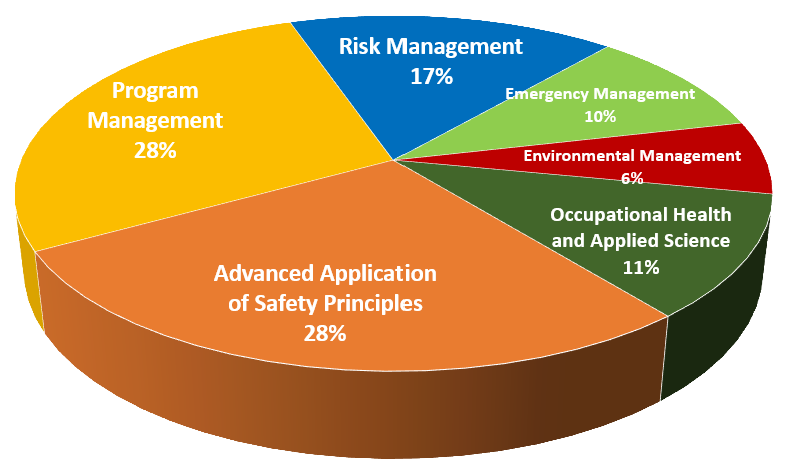
To begin, it helps to review BCSP’s CSP exam content outline and knowledge areas. BCSP organizes the exam into major topic areas that reflect the responsibilities of professional-level safety practitioners. These categories represent the types of competency CSP candidates are expected to demonstrate, such as:
-
Advanced Application of Safety Principles — 25%
-
Program Management — 25%
-
Risk Management — 15%
-
Emergency Management — 9%
-
Environmental Management — 6%
-
Occupational Health and Applied Science — 10%
-
Training — 10%
Some exam domains tend to carry more weight than others, so it’s important to study strategically, not equally. Start by assessing how well you understand each domain and determine where you need the most development. Many CSP topics are tested in depth, meaning that simply being “familiar” with a subject may not be enough to perform well on exam questions.
When reviewing the exam blueprint, be objective and honest about your current competency levels. This helps prevent underestimating the workload—or spending too much time on areas you already know well. A clear self-assessment allows you to build a smarter plan, focus on your weaker areas, and improve efficiently over time.
References
We have utilized a variety of reference resources to develop our CSP preparation courses, packages, and bundles based on what has been outlined by the Board of Certified Safety Professionals (BCSP). A key resource is the BCSP CSP Examination Blueprint, which identifies the major domains and competencies covered on the examination.
Another important resource is the BCSP CSP Blueprint References, which includes references frequently used by subject-matter experts in developing CSP examination questions. BCSP also recommends that candidates become familiar with applicable regulations, standards, and professional safety practices.
CSP Examination Length & Format
To give you an idea of the BCSP CSP examination format and length, candidates are currently provided approximately 5.5 hours to complete the examination. The exam is computer-based and follows the current BCSP CSP Examination Blueprint.
The examination is designed to assess more than simple knowledge and memorization. Candidates should be prepared to apply safety principles, interpret information, analyze workplace situations, perform calculations, evaluate risks and controls, and select the most appropriate response based on professional safety practice.
How do I make a plan and get started?
Any approach that you use in preparing for the CSP exam, as long as it works for you, can be a good plan. However, this does not mean that studying or preparing randomly based on your “in-the-moment feelings” will be effective. Instead, you should follow a structure that suits your specific situation, learning style, and timeline.
Next, talk to people in your life who support you. Let them know how becoming CSP certified may impact your career and professional development. Share how your studies will help strengthen your safety knowledge and allow you to contribute to your organization at a higher level. By expressing your goals and getting the support of others, you make your commitment more real and increase your motivation to follow through.
Then, make your study plan. You need to know exactly how much time you have before the date of your CSP exam. After identifying all of the content and subject matter you need to cover, work backwards and develop a plan with clear deadlines and objectives. Be sure to account for your work schedule, holidays, travel plans, and anything else that may interfere with your studies. Be realistic—do not commit to an unnecessarily condensed timeline, but do not take it too easy either. Follow a structure and timeframe that works for you.
How detailed you make your CSP study plan depends on personal factors such as your prior level of knowledge, experience, study habits, and available time. In general, breaking your study plan into weekly objectives can help you monitor your progress and stay on schedule.
Overall, make sure to allocate enough time to work through all of the CSP exam materials well before your examination date. For some candidates, enough time may mean two to three hours of study per day, while others may require additional time. Ideally, you should complete the main content several weeks before the exam so that you have sufficient time for review, calculations, and practice questions.
Study Approach Based on Accomplishment
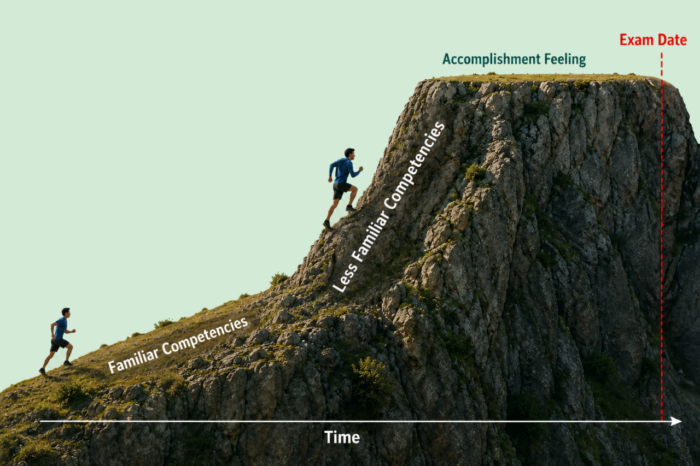
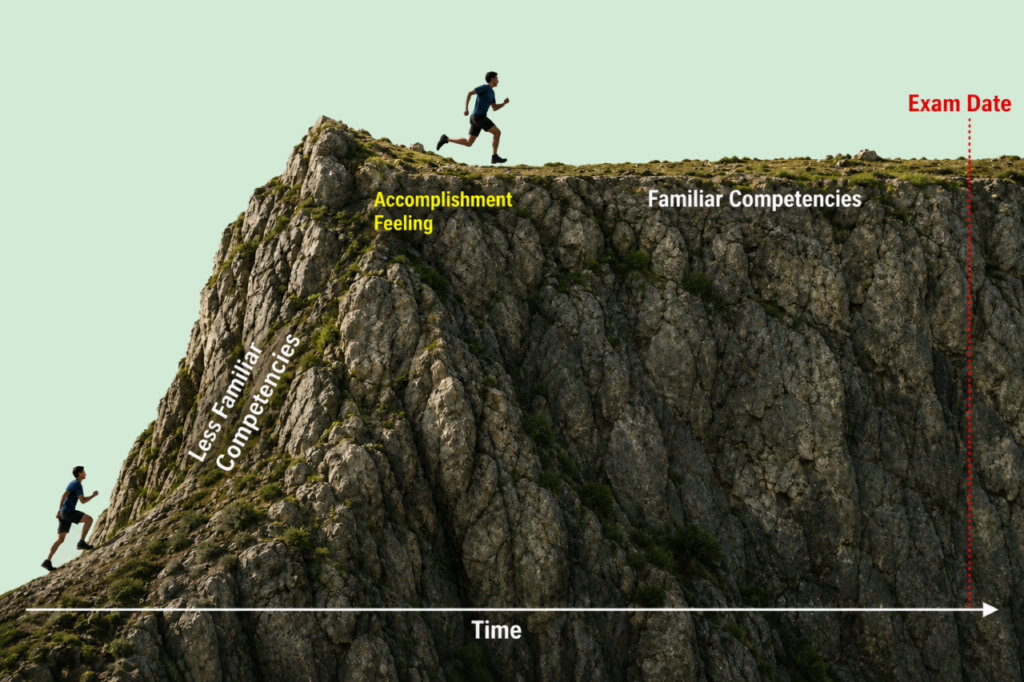
When structuring your CSP study plan, it is important to consider the order in which you approach the content. A common question is, “In what order should I study the modules?” Most individuals tend to begin with the content they are most familiar and confident with.
As human beings, we naturally look for the easiest path available. Although the logic behind this approach is understandable, it can create problems when estimating preparation time. Starting with familiar material may create a feeling of rapid progress and confidence early on. However, when you eventually reach the more difficult content, your progress may slow considerably and increase your stress as the examination date approaches.
Taking an alternative approach by focusing on what you do not know first can reduce the risk of having to cram difficult material near the end of your preparation.
Tip: Take the “Less Familiar First” Approach!
Following this approach helps ensure that you give yourself enough time to understand and overcome the more difficult areas of the CSP material. It can also give you a strong sense of accomplishment early in your preparation and reduce the possibility of increased stress closer to the examination.
The potential disadvantage is that you may begin to forget some of the difficult material you studied earlier. Therefore, candidates who follow this approach should regularly return to the less familiar subjects and review them so that the information remains fresh as the examination date approaches.
Tip: We Recommend a Dynamic Approach
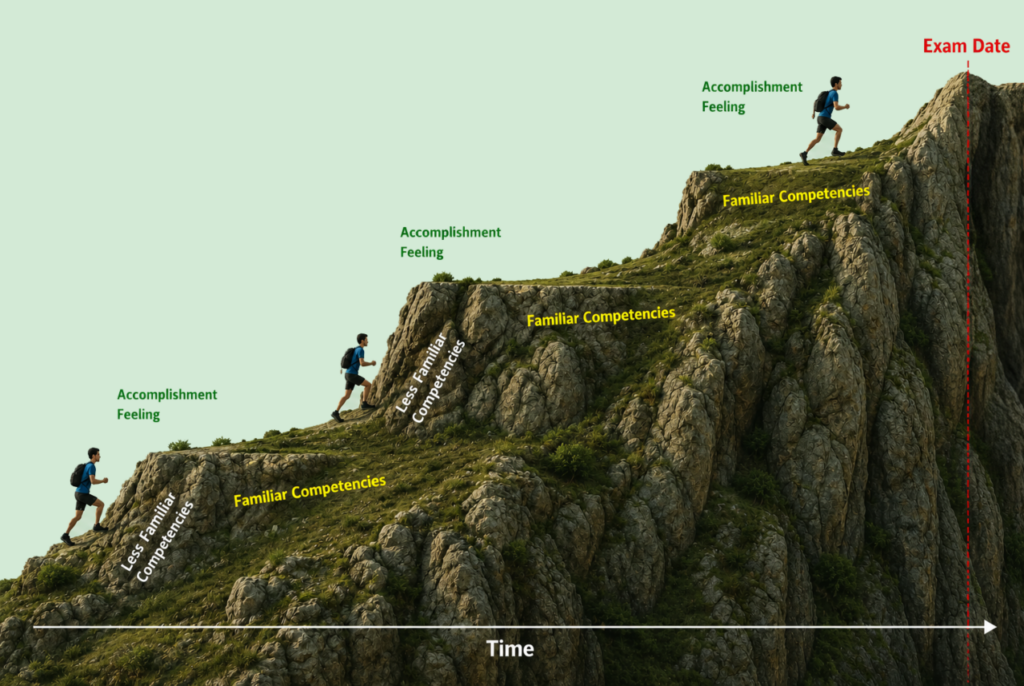
Using a dynamic study plan for the CSP exam combines the advantages of studying both familiar and less familiar competencies. Instead of completing all difficult topics first or all familiar topics first, alternate between the two throughout your study period.
For example, you may spend one or two weeks studying a more challenging CSP domain and then move to a domain in which you are more confident. You can then return to another challenging area.
This approach allows your sense of accomplishment to develop gradually while distributing the more demanding material throughout your study period. It can help you manage your workload, maintain motivation, reduce unnecessary stress, and lower the risk of burnout as you prepare for the CSP examination.
Check out our other blog posts!


