How to Choose the Right ASP Exam Date

When should you do this?
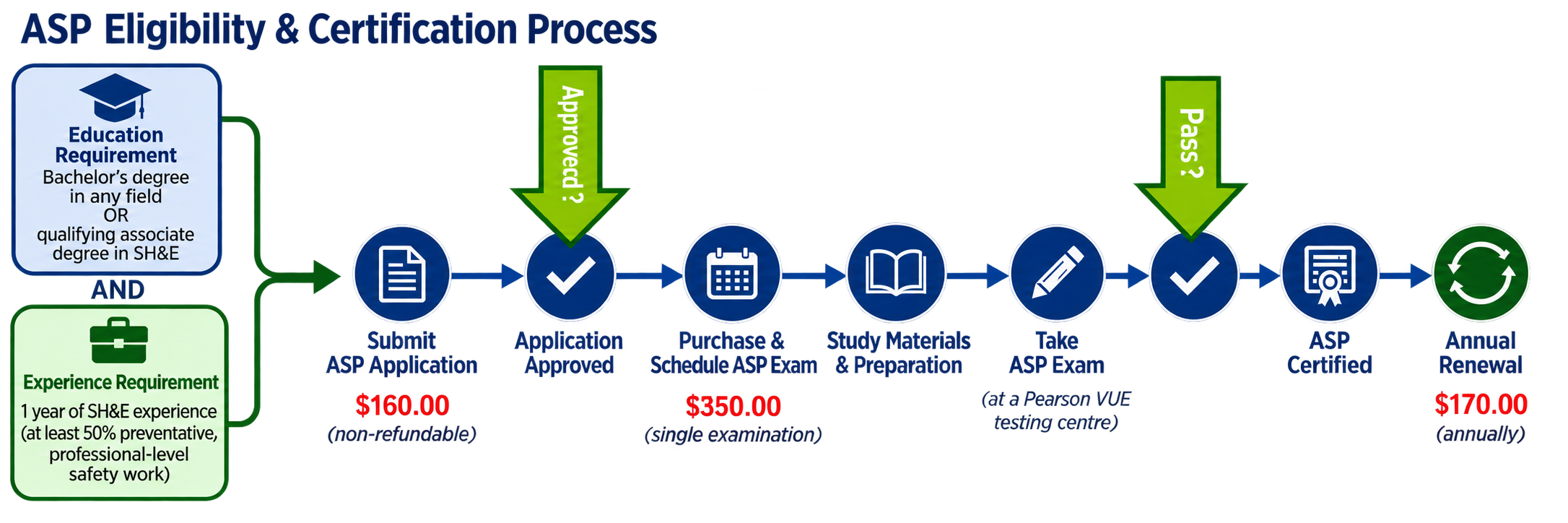
So you’ve applied and been approved by the Board of Certified Safety Professionals (BCSP) to take the Associate Safety Professional (ASP) exam. Congratulations! Now you need to decide when to take the exam. But which date is right for you?

Picking the right exam date

Once your ASP application is approved, BCSP provides an eligibility period during which you must purchase and complete your examination. Unlike the CRST process, the ASP exam is not limited to a few specific testing periods during the year. You can schedule your computer-based exam based on testing availability and your preparation schedule.

When selecting your exam date, consider how much time you realistically need to cover the ASP Examination Blueprint, practise calculation and application-based questions, complete mock exams, and strengthen your weaker areas. At the same time, avoid waiting until the very end of your eligibility period, as this gives you less flexibility if your plans change or you need another attempt.

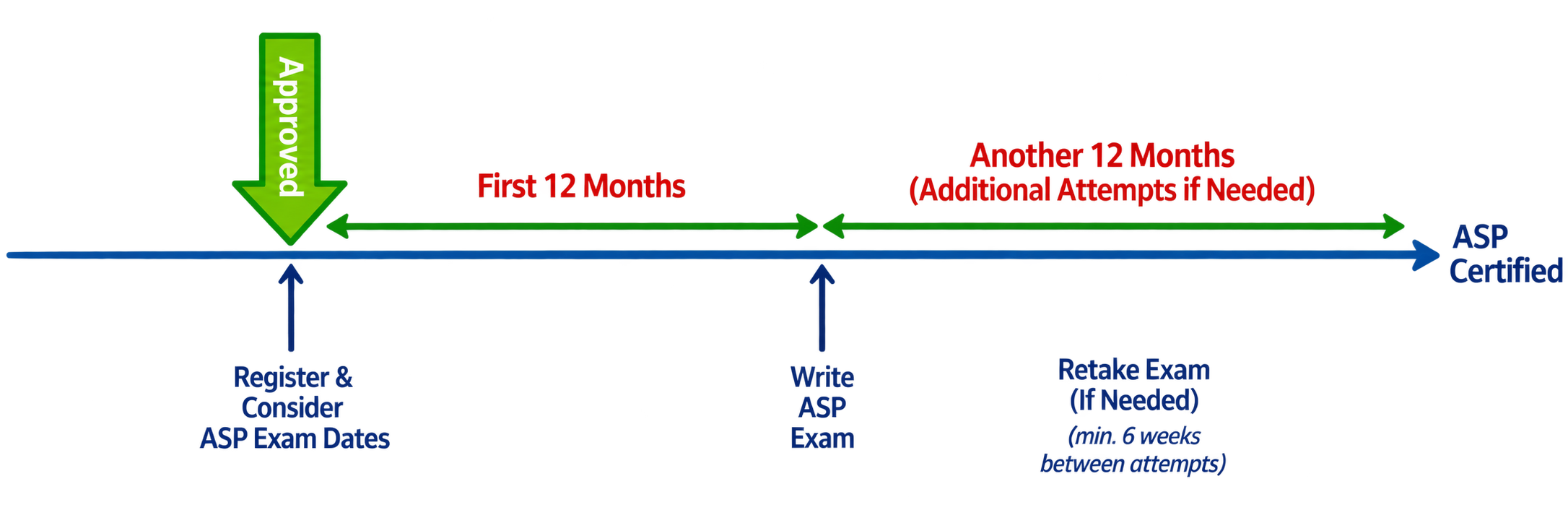
If you do not pass the exam on your first attempt, BCSP allows you to retake it, but you must wait at least six weeks between examination attempts. Therefore, your first exam date should leave enough time within your eligibility period for additional preparation and another attempt if necessary.

The diagram below demonstrates a practical approach. Rather than scheduling your first attempt at the very end of your eligibility period, consider choosing a date that gives you sufficient preparation time while still leaving a reasonable buffer afterward. This provides greater flexibility and reduces unnecessary pressure as you work toward earning your ASP certification.

But this timeline could be shorter!

Assume that a candidate takes the ASP exam three months after their application has been approved but is unsuccessful on the first attempt. The candidate does not need to wait until the end of the eligibility period to try again. However, BCSP requires a minimum six-week waiting period between exam attempts.

Therefore, candidates who schedule their first attempt earlier can potentially complete the entire ASP examination process much sooner. They also have more time available to review weaker areas and prepare for another attempt if needed.

Keep in mind that each additional exam attempt requires payment of the applicable BCSP examination fee. The diagram below illustrates how an earlier first attempt can shorten the overall certification timeline while providing flexibility for retesting if necessary.

How long do you need to prepare for the ASP exam?

Moving on to exam preparation, you can see why timing and planning are so important. If you have a strong safety background and are already comfortable with the topics covered in the ASP Examination Blueprint, you may be ready to take the exam relatively soon after your application is approved. On the other hand, if you have not yet studied the material or need additional time to strengthen certain areas, it may be better to schedule your exam later and give yourself sufficient time to prepare.

As an example, we recommend considering a 2- to 4-month preparation window between your application approval and your ASP exam date. However, there is no single preparation period that works for everyone. Your timeline should reflect your existing knowledge, work and personal commitments, and familiarity with the ASP exam content.

Tip: One of the best strategies for anyone preparing for the ASP exam is to select a realistic exam date and commit to it. Once you have considered your schedule and assessed how comfortable you are with the exam content, setting a date gives you a clear deadline to work toward. This can help you stay accountable, structure your study plan, and maintain consistent progress throughout your preparation.

Check out our other blog posts!

About the ASP


The Canadian Registered Safety Technician (ASP) certification is a widely accepted form of recognition by industry and government in Canada. This certification is given by the Board of Canadian Registered Safety Professionals (BCSP), a public interest and not-for-profit association. Founded in 1976, this group is dedicated to the principles of health and safety as a profession. The BCSP administers occupational health and safety exams and certifies qualified occupational health and safety professionals.

About the CSP

The Canadian Registered Safety Professional certification is a widely accepted form of recognition by industry and government in Canada. This certification is given by the Board of Canadian Registered Safety Professionals (BCSP), a public interest and not-for-profit association. Founded in 1976, this group is dedicated to the principles of health and safety as a profession. The BCSP administers occupational health and safety exams and certifies qualified occupational health and safety professionals.

How to be a great CSP and ASP test taker

We’ve talked a lot about planning so far and how to approach scheduling. However, the key point which is foundational to success is being realistic with yourself. No matter how detailed or specific your plan is, if it isn’t realistic and reflective of your circumstances, then it will not work. Individuals and companies who do not have expectations that reflect the reality of their circumstances always end up with a result that falls short or is not what they were aiming for. Not only that, but it also often creates unnecessary stress and losses.

How to choose the right ASP exam date

So you’ve applied and gotten approved by the BCSP to take the ASP exam. Congratulations! Now, you need to pick an exam date. But which one? Overall it could be said that you have 24 months and 3 attempts to write the ASP exam. However, this is only possible if you write the first exam at the end of the first year. The reason for this is because, following the first attempt you will have 12 months to use your other 2 attempts. Let’s take a look at some examples.

How to choose the right CSP exam date

So you’ve applied and gotten approved by the BCSP to take the CSP exam. Congratulations! Now, you need to pick an exam date. But which one? Overall it could be said that candidates have 24 months and 3 attempts to write the CSP exam. However, this is only possible if candidates write the first exam at the end of the first year. The reason for this is because, following the first attempt, they will have 12 months to use the other 2 attempts. Let’s take a look at some examples.

How to make a CSP exam preparation strategy that works for you

There’s more to successfully passing the CSP exam than just studying and memorizing textbook materials. As a future candidate, it’s not enough to simply have memorized the various concepts and terminologies to get a good mark. You MUST be able to bridge the gap between what you have learned and its real-world applications. Let’s review some proven methodologies to implement into your preparation which will ensure your success in both the CSP and in your future career.

How to make a ASP exam preparation strategy that works for you

There’s more to successfully passing the ASP exam than just studying and memorizing textbook materials. As a future candidate, it’s not enough to simply have memorized the various concepts and terminologies to get a good mark. You MUST be able to bridge the gap between what you have learned and its real-world applications. Let’s review some proven methodologies to implement into your preparation which will ensure your success in both the CSP and in your future career.

What’s the difference between the CSP and ASP?

According to the Board of Canadian Registered Safety Professionals, Canadian Registered Safety Professionals (CSPs) are “operational health and safety [OHS] professionals [who design] strategy relating to the organization and management of OHS within the wider context of business processes and external regulatory, market and societal influences. They are influential with senior management and are involved in problem solving and organizational review and change as advisers and consultants.”